

Microsoft has published a patent application describing AI that could replace a speaker’s words during a live video and adjust their mouth movements to match. Translation and cleaner audio are obvious attractions. But one detail changes the conversation: the version you hear could depend on who you are.
Imagine watching a live conference with someone sitting beside you. You see the same speaker, at the same moment, on the same stage. Yet the two of you might hear different words—and see lip movements tailored to the respective audio tracks.
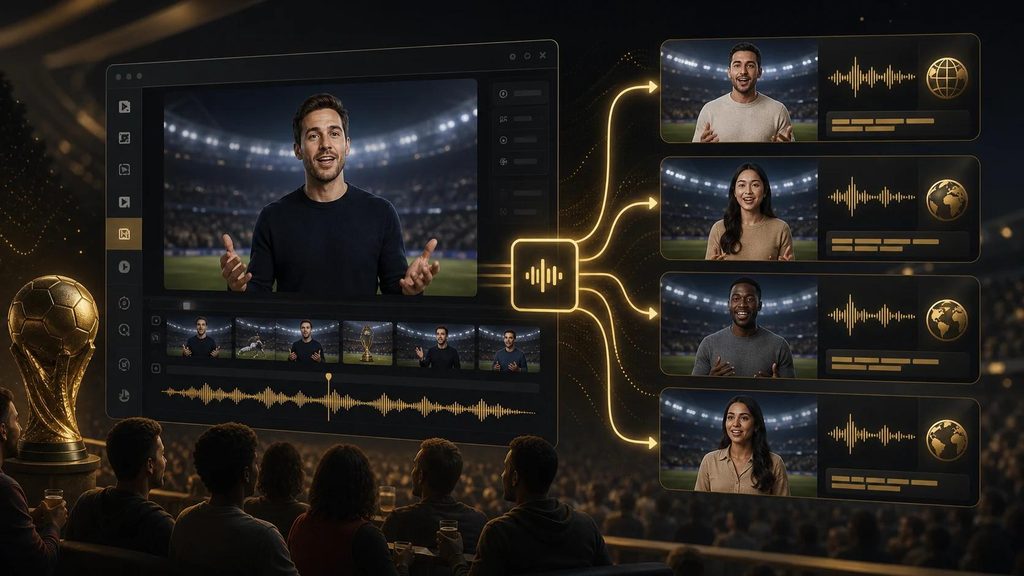
That is a possibility raised by a Microsoft patent application, US 2026/0341309 A1, published on October 29, 2026. The filing describes AI-assisted changes to live audio and video, with replacements influenced by rules and a viewer profile. The proposed system can also regenerate video frames so a speaker’s lips match the modified speech.
The crucial distinction: this is a published patent application, not an announced Microsoft product or proof that such a system works as described. Read the patent filing.
What the Microsoft Filing Actually Says
The application, titled Near Real-Time Artificial Intelligence (AI) Enhancement of Video or Augmented Reality (AR) Presentations of Live Events, was filed on April 29, 2025, by Microsoft Technology Licensing. It covers an approach to modifying live presentations and, in other embodiments, previously recorded video.
Its live-video design includes several connected stages:
- An AI system examines a live audio and video feed.
- It identifies spoken words that meet specified editing criteria.
- A generative system creates replacement audio and smooths the surrounding sound.
- It modifies corresponding video frames, including mouth movements, to align the picture with the revised words.
- The edited version is presented to the viewer after a short delay.
The application defines near real time using an example window of roughly one to ten seconds. That is a design description, not a published benchmark showing that a working implementation consistently meets the target. The document discusses devices including phones, tablets, cameras and augmented-reality glasses. Patent description and claims.
What Gets Changed?
The filing lists a surprisingly broad range of possible edits: filler sounds, mispronunciations, colloquial expressions, mumbled words and offensive language. Separate claims cover translating speech into a language understood by the viewer and generating matching video frames.
At first glance, the benefits are straightforward. A technical lecture could be easier to understand. Live interpretation could become more natural. A recording could be more accessible to someone who speaks another language.
But those examples also expose a boundary. Cleaning up a pause is not the same as replacing a statement. Translating a sentence is not the same as correcting its meaning. All three can involve AI-generated words that were not spoken in the original feed.
The Most Important Detail Is Personalization
The main claim describes selecting words for modification according to rules and a profile of the viewer. Other claims list possible profile attributes such as spoken languages, age and location, along with additional personal characteristics. These are possible inputs described in the application—not evidence that Microsoft currently collects them for this proposed feature.
This matters because a conventional broadcast provides a shared audiovisual record. Different people may interpret it differently, but they can refer to the same original utterance.
A personalized editing system could change that arrangement. Two viewers could receive distinct versions of the same event, selected for different language needs or content preferences. That outcome is an inference from the described design, rather than a demonstrated Microsoft deployment.
Consider three hypothetical modes:
- Translation: One viewer receives an English rendering of a speaker’s original German remarks.
- Accessibility: Another receives an edited stream with disfluencies reduced.
- Content filtering: A third receives substitutions based on predefined rules.
Each mode has a plausible purpose. Yet the more invisible the transformations become, the harder it is for an audience to know where the speaker’s actual words end and the platform’s editorial decisions begin.
A Lip-Synced Edit Is Not Just a Subtitle
Subtitles add an interpretation alongside the original video. Dubbing replaces an audio track. Microsoft’s filing goes further by describing changes to the visual evidence itself: a viewer could see the speaker apparently forming the new words.
The technical appeal is obvious, particularly for cross-language video. The trust problem is just as real. Lip synchronization can make an altered statement feel as if it came directly from the speaker.
The filing includes an option to preserve original audio and video as a reference record, described in dependent claim 14. That is a meaningful design possibility, but it is not a blanket guarantee that every implementation would retain originals or give viewers access to them. The independent live-editing claim does not set out an explicit viewer-notification requirement for each changed segment. Claims 1, 14 and 16.
This absence in the patent claims should not be confused with a conclusion about every law or policy that a future product would have to obey. It identifies an unresolved product-design question:
How would viewers know that the apparent speaker is no longer the sole author of the words they hear?
Microsoft Already Translates Speech. This Patent Is Different.
Microsoft’s shipping Interpreter agent in Teams offers real-time speech translation and can, with appropriate settings, simulate a participant’s voice in the translated audio. Microsoft’s documentation says participants see an indication when interpretation is active, and meeting recordings retain the original meeting audio rather than the translated audio.
That is not the same as changing a speaker’s lip movements to match substituted words in a live video. The distinction matters: an existing translation product should not be presented as proof that the patented lip-editing system has shipped. Microsoft Teams Interpreter documentation.
The existing product nonetheless shows why the idea is attractive. Once a system can recognize speech, translate it and synthesize a plausible voice, visual alignment becomes a natural next research direction. Whether that last step can be delivered reliably, transparently and responsibly remains a separate question.
The Patent Status Matters, Too
News headlines sometimes compress “patent application” into “patent.” In this case, doing so would give the wrong impression.
The Microsoft document is a published US patent application, not an issued patent. Patent-tracking reporting describes an examiner rejection of the claims as filed in July 2026; that is a procedural step to which an applicant may respond. It does not establish that Microsoft has a commercially usable system, nor does it prove that the idea will ultimately receive patent protection. Patent tracker analysis.
We have not found a Microsoft announcement of a release date, public demo or consumer launch for the specific live lip-rewriting design described in the filing.
The Promptor Perspective: Translation Is Help. Invisible Rewriting Is Editorial Power.
The strongest question is not whether AI should ever improve speech. We already accept captions, interpretation, noise reduction and editing in many settings.
The question is who gets to decide which words count as the authentic version of an event.
A platform that translates language performs an interpretive task. A platform that replaces offensive terms performs moderation. A platform that substitutes supposedly corrected facts may begin to make editorial judgments. These functions have different purposes and need different safeguards.
Our position is that the more extensively a system transforms a live speaker’s words and appearance, the more important it becomes to preserve provenance and communicate the nature of the alteration. A clear indication of transformation, access to the original where appropriate and a way to distinguish translation from substantive rewriting would help people evaluate what they are seeing.
That is a proposed governance approach, not a feature Microsoft has promised for this patent application.
Five Questions Every Viewer and Publisher Should Ask
Before adopting any system that changes live speech and synchronized video, ask:
- Who authorized the transformation? The speaker, broadcaster, viewer or platform?
- What kind of edit was applied? Translation, cleanup, filtering or substantive substitution?
- Can an audience recognize the altered version? Is disclosure visible and understandable?
- Can the original be authenticated? Is there a trustworthy reference recording or provenance trail?
- Who corrects a harmful change? What happens when the replacement misrepresents the original speaker?
The technology described in this filing could make live media easier to understand across languages. It could also make the familiar idea of “I heard them say it” considerably less reliable if transformations are invisible.
The future of live video may not be about whether an image is real. It may be about whether the words inside that real-looking image are still the speaker’s own.
Sources and Further Reading
- Microsoft patent application US 2026/0341309 A1 — original published description and claims, mirrored by Justia
- Patentlyze — filing details and patent-status reporting, October 30, 2026
- Microsoft Support — Interpreter in Microsoft Teams meetings and calls
- TechSpot — independent report on the application, November 7, 2026